Sri Chaitanya Mahaprabhu — 3
No matter how many affirmations Nimai whispered to himself, the grief of Lakshmi Priya’s passing lingered as a silent weight upon his heart. Days blurred into one another as he immersed himself in work — a futile attempt to escape the vast shadow that had fallen over his once-radiant world.
Sachi watched her son’s relentless struggle with aching concern. Unable to bear his sorrow, she urged him to remarry. Yielding to her insistence, Nimai wed Vishnu Priya, a girl who had not yet reached adolescence. (Note: Child marriage was once common in India, though it is now rightly prohibited.)
As was customary, Vishnu Priya continued to live with her parents, while Nimai remained withdrawn, his heart still bound to the memory of Vishnu Priya. Years passed in this quiet melancholy.
When it was almost time for Vishnu Priya to join him, Nimai felt an inner call to visit the sacred town of Gaya. With Sachi’s blessing, he embarked on a foot pilgrimage with a few close friends.
In Gaya, with utmost devotion, Nimai performed the śrāddha (ritualistic funeral) rites for his departed wife. After completing the ceremonies, he offered homage to Lord Shiva, praying with tears in his eyes:
“Lord, please raise me above this endless cycle of birth and death.”
Soon afterward, he met with the venerable Ishvara Puri, who resided in Gaya. The saint greeted him with immense love.
“Last night,” Ishvara Puri said, “I dreamt of you, and you appeared as Lord Vishnu Himself.”
Nimai smiled wistfully and bowed.
“Revered one,” Nimai said humbly, “give me a mantra that will bring me peace.”
Ishvara Puri hesitated. “How can I give you a mantra? You are Sri Krishna Himself — it is I who should bow before you.”
But at Nimai’s gentle insistence, the saint initiated him into the sacred Gopala Mantra. Nimai embraced the chant with unwavering devotion, and within days, he was immersed in bhaava samadhi — oneness with the Divine through pure love.
The speed of his awakening affirmed the truth of Ishvara Puri’s vision. In that state of ecstasy, Nimai proclaimed: “I am Krishna! I have reached home — there is nowhere else to go.”
Concerned for Sachi, his friends implored him to return to Navadvīpa. But Nimai was transformed — the proud scholar and grieving spouse was now a humble devotee, detached from the world and united with the Divine.
Still, Nimai forced himself to return. But by the time he reached Navadvīpa, word of his awakening had already raced ahead. The people gathered in awe — some beholding a god reborn, others murmuring that reason had fled him.
Meanwhile, Vishnu Priya, newly arrived to share his home, breathed a sigh of relief at his return. But Nimai’s mind had turned inward; he was untouched by the bonds of worldly affection.
“You took away my first son and my husband,” Sachi lamented to God. “Please, let Nimai stay with me.”
Destiny, however, had other plans.
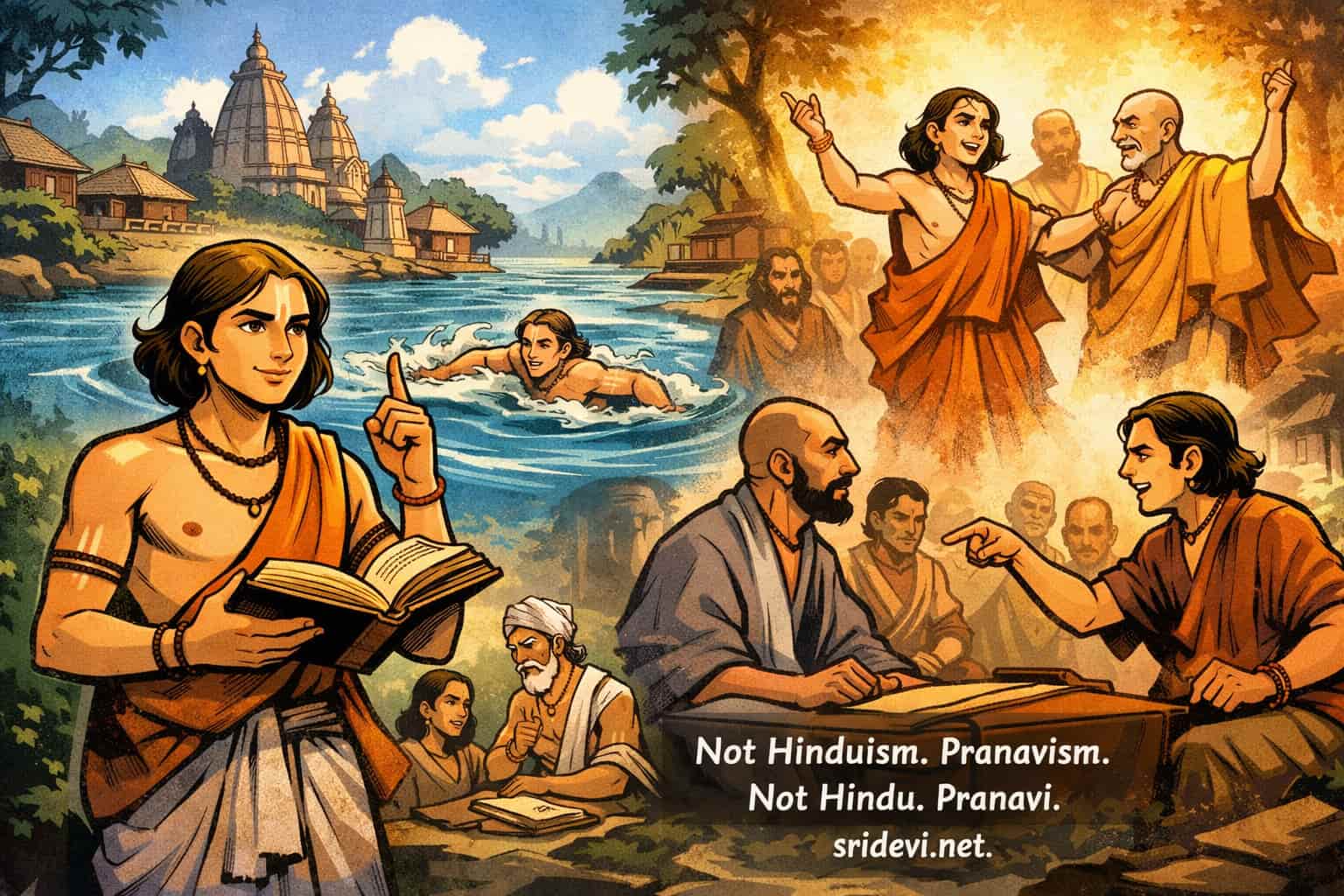
One day, Nimai declared before his students, “Pack away your scriptures — they serve no one now. I chased knowledge and wealth, but devotion alone is eternal.”
His words startled the scholarly community. Against the backdrop of protests, Nimai walked with his students to the Ganga River.
“From this day,” he announced, casting away his books into the river, “I will teach only one lesson — the name of the Divine.”
His actions ignited a tumultuous uproar. Most of his students abandoned him in protest. Yet a few remained and asked, trembling, “How shall we call upon God without spiritual wisdom?”
In that instant, Nimai clapped his hands, raised his arms high, and began to sing:
Haraye Namaḥ, Kṛṣṇa Yādavāya Namaḥ Gopāla Govinda Rāma Śrī Mādhusūdana
Nimai’s melodious voice rang through the air, and his students danced with him. Neighbors heard the sacred chorus and came forth; soon, the entire town was swept up in divine celebration.
Thus began the Saṅkīrtana Movement, later known to the world as the Hare Rāma Hare Kṛṣṇa movement — a river of devotion that would flow on for centuries.
Shortly after, in a state of divine trance, Nimai declared: “Advaita Acharya is Nara — Shiva Himself, and I am Narayana. Yet I still await my eternal brother.”
Shortly after, Navadvīpa witnessed the arrival of a renunciate monk — Sri Nityananda Mahaprabhu, affectionately called Nitai. Nimai rushed forward to welcome the one he recognized as his eternal spiritual brother — one soul in two bodies.
The arrival of Nitai infused new vigor into the movement. The three divine pillars — Nimai, Nitai, and Advaita Acharya — walked the streets of Navadvīpa, singing the Lord’s name and awakening hearts wherever they went. The tide of devotion swelled beyond measure.
But Sachi’s deepest fear soon came true.
“It is time,” Nimai announced, his voice steady with divine resolve. “I must take monkhood and spread devotion throughout the world.”
“Gauranga — the golden one, please do not leave us!” the devotees cried.
Yet his decision was unshakable.
As dawn approached on the day of departure, devotees from far and wide gathered to see him one last time. Sachi sat awake through the night, afraid her son would slip away unseen.
Before sunrise, Viśvambhara called Vishnu Priya to him — perhaps for the first time. With tenderness, he adorned her like a goddess and bowed before her, as if in silent apology.
Then, circling his mother in reverence, he stepped out of Navadvīpa — never to return as the person they once knew.
After his departure, Vishnu Priya continued the Saṅkīrtana movement in Navadvīpa, embracing a life of quiet renunciation and unbroken devotion.
Some time later, news reached the town that Nimai had received the ochre robes from Sri Kesava Bharati. From that moment onwards, the world knew him by a new name — Sri Chaitanya Mahaprabhu — a beacon of bhakti, whose love for the Divine would illuminate hearts across the ages.