Bhikshuka
Scripture: Bhikshuka Upanishad.
Canonical Number: 60 out of 108.
Shanti Mantra: pūrṇamadaḥ
Interlocutors: Not specified in the text.
Context, Setting, Timeframe: Not specified in the text.
Theme:
The Four Kinds of Renunciates
Teachings:
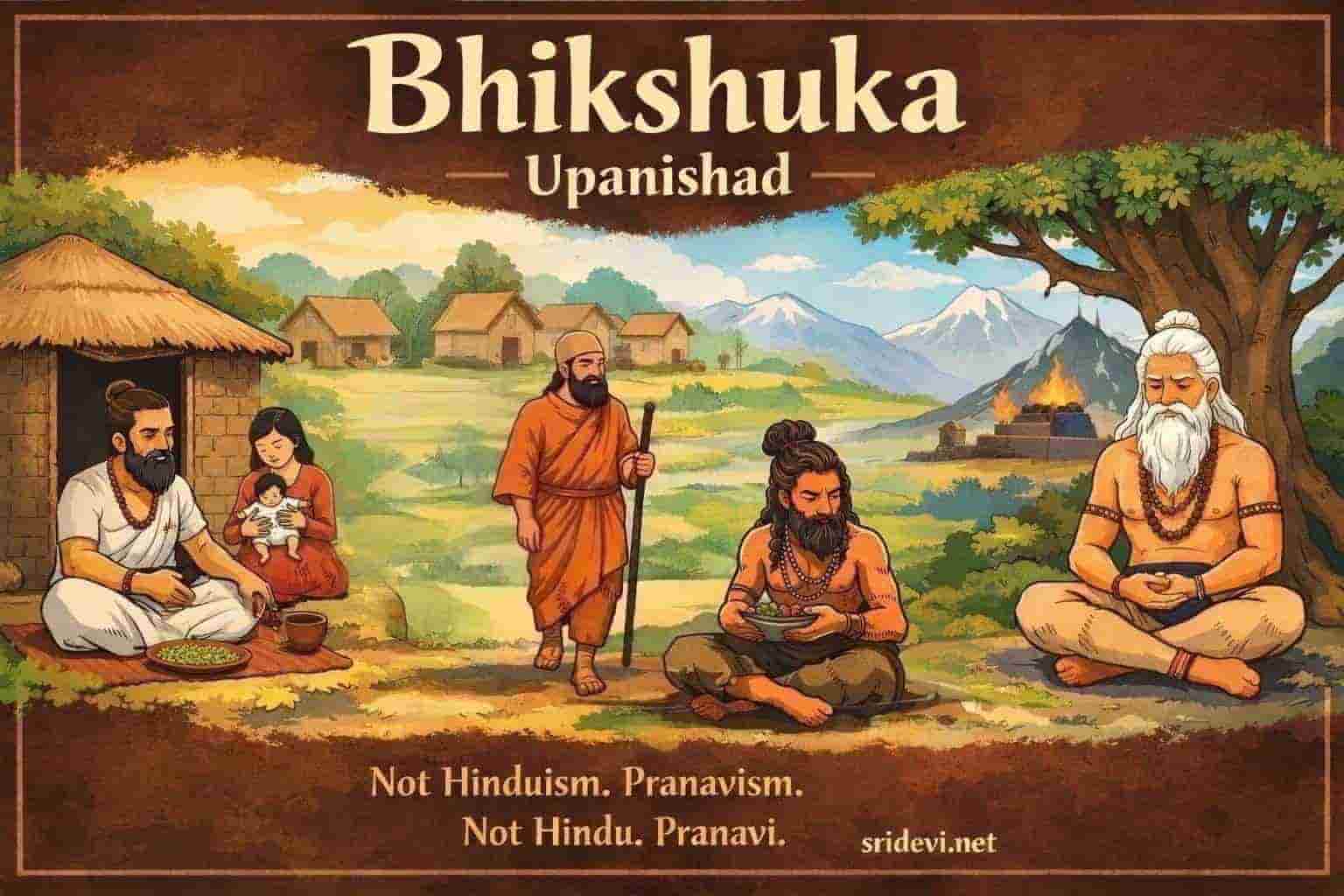
Of the renunciates (bhikṣū) who sought liberation alone on some yogic path, there were four kinds. As follows:
1. Kuṭīcaka Bhikṣū
Kuṭīcaka literally means “hut-dweller.” This category included home-dwelling renunciates such as Gotama, Bharadvāja, Yājñavalkya, and Vasiṣṭha.
They restricted their food to eight mouthfuls. [i.e., a formal rule of moderation and non-indulgent eating; in practical terms, this meant multiple small intakes rather than full meals.]
2. Bahūdaka Bhikṣū
Bahūdaka literally means “many waters,” suggesting a wandering mendicant who moved from place to place — like a bird moving from one water body to another. They lived on alms, wore ochre robes, and carried the signs of monkhood: the staff (daṇḍa) and water-pot (kamaṇḍalu).
As a rule, they went on alms rounds through up to eight villages and avoided luxury foods, even when offered. [i.e., if they found no food within eight villages, they went without eating.]
3. Haṃsa Bhikṣū
Haṃsa means “swan,” a symbol of purity and spiritual discernment. These wandering renunciates practiced severe austerities. And they did not stay long in any one place:
- One night in a village
- Five nights in a town
- Three months in the countryside
- Beyond that, they stayed nowhere
Their diet consisted only of what was excretory in nature. [i.e., an extreme form of non-dependence on cultivated or cooked food.]
4. Paramahaṃsa Bhikṣū
Paramahaṃsa means “supreme swan,” symbolizing the highest state of renunciation. This category included exalted renunciates such as Saṃyāta, Kāruṇya, Utvega, Jaḍa Bharata, Dattātreya, Śuka, Vāmadeva, and Hārītaka.
A paramahaṃsa transcends conventional notions of dharma and adharma. [i.e., they are no longer bound by external codes of conduct or religious beliefs because they have made renunciation an inner state of purity and goodness.]
In Paramahaṃsa Mode
A paramahaṃsa renunciate typically:
- Ate only for bare survival.
- Withdrew from worldly pursuits.
- Continued seeking alms through only up to eight villages. [i.e., if a bahūdaka bhikṣū earlier.]
- Wore patched garments or went naked. [i.e., if a haṃsa bhikṣū earlier.]
- Lived in places scarcely called homes: under trees, cremation grounds, deserted enclosures, riverbanks, mountain caves, etc. [i.e., if a haṃsa bhikṣū earlier.]
But beyond outward appearance, a paramahaṃsa was characterized by their inner state:
- They did not differentiate people by caste or social class.
- They saw the Self (Divine) in all.
- They remained inwardly absorbed in meditation.
- They transcended dualities: gain–loss, pure–impure, etc.
- They were firmly established in their Inner Divine alone.
- Their minds were purified.
- Ultimately, they transcended even attachment to the body.