Hayagriva
Scripture: Hayagriva Upanishad.
Canonical Number: 100 out of 108.
Shanti Mantra: Bhadraṃ karṇebhiḥ.
Interlocutors: Narada. Brahmā (teacher).
Context, Setting, Timeframe: Not specified in the text.
Theme:
The Glorious Hayagrīva Mantras
Teachings:
Reciting the Hayagrīva mantras with devotion is said to bestow the same results as mastering all the scriptures. These mantras reflect the Mahāvākyas — the great, quotable declarations of the Upaniṣads:
- prajñānaṃ brahma — Direct realization is Divine
- ahaṃ brahmāsmi — I am Divine
- tat tvam asi — That You Are
- ayam ātmā brahma — The Inner Self is Divine
How is this conveyed through mantra?
In the Hayagrīva mantras, vowels are understood as the Divine presence, while consonants represent the individual soul. Just as vowels and consonants unite to form meaningful chants, the individual soul and the Divine are already united.
This understanding is to be held while reciting the Hayagrīva mantras.
The One-Syllable Mantra
Hayagrīva’s seed syllable (bīja) is hlauṃ.
This single syllable is regarded as Brahma-Vidyā, a transcendental mantra. It is traditionally chanted on the eleventh day of the lunar month (Ekādaśī).
This scripture states that Hayagrīva’s one-syllable mantra was transmitted through an unbroken lineage: Brahmā → Maheśvara → Saṃkarṣaṇa → Nārada → Vyāsa → the world.
Meditation on Hayagriva
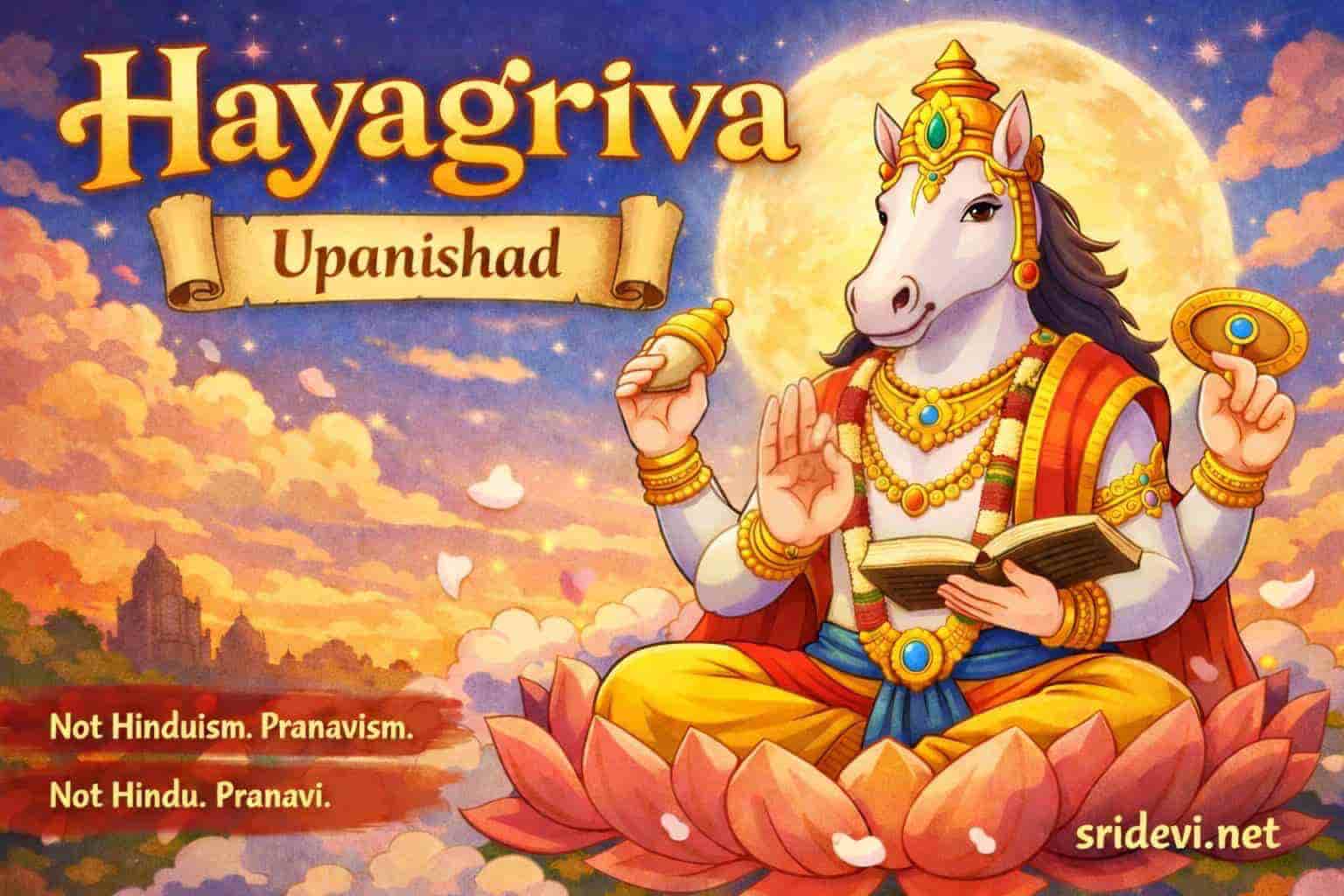
śaṅkha-cakra-mahāmudrā-
pustakāḍhyaṃ caturbhujam |
saṃpūrṇa-candra-saṃkāśaṃ
hayagrīvam upāsmahe ||
The four-armed one —
holding a conch and discus,
displaying the mahā-mudrā
(a hand gesture of wisdom),
and bearing a book;
we meditate upon Hayagrīva,
radiant like the full moon.
Hayagrīva Mantras: 1, 2, and 3
viśvottīrṇa-svarūpāya
cinmayānanda-rūpiṇe |
tubhyaṃ namo hayagrīva
vidyārājāya viṣṇave
svāhā svāhā namaḥ || 1 ||

ṛg-yajuḥ-sāma-rūpāya
vedāharaṇa-karmaṇe |
praṇavodgītha-vapuṣe
mahāśva-śirase namaḥ
svāhā svāhā namaḥ || 2 ||

udgītha-praṇavodgītha
sarva-vāgīśvareśvara |
sarva-vedamaya acintya
sarvān bodhaya bodhaya
svāhā svāhā namaḥ || 3 ||
Salutations to You, Hayagrīva —
whose nature transcends the universe,
whose form is awareness-filled and blissful;
to Viṣṇu, the King of knowledge —
offer my self (in surrender) with salutations.
Salutations to Him —
whose form is Ṛg, Yajus, and Sāma,
whose sacred act was the retrieval of the Vedas,
whose body is Praṇava and Udgītha
(Om as the source and the chant);
the great horse-headed One —
offer my self with salutations.
O Udgītha, O Praṇava-Udgītha,
Supreme Lord of all masters of speech,
embodiment of all the Vedas,
the inconceivable —
awaken all, awaken all;
offer my self with salutations.
Auxiliary Details of the Above Three Mantras:
brahmātri-ravisavitṛ-bhārgavā ṛṣayaḥ |
gāyatrī-triṣṭubh-anuṣṭup chandāṃsi |
śrīmān hayagrīvaḥ paramātmā devatā iti |
hlauṃ iti bījam |
so’ham iti śaktiḥ |
hlūṃ iti kīlakam |
bhoga-mokṣayor viniyogaḥ |
akārokāra-makārair aṅganyāsaḥ |
- Seers (Composers): Brahmā–Atri, Ravi–Savitṛ, and Bhārgava
- Meters: Gāyatrī, Triṣṭubh, and Anuṣṭubh
- Deity: The revered Hayagrīva
- Bīja (seed syllable): hlauṃ
- Śakti (power): so’ham
- Kīlaka (locking-unlocking syllable): hlūm
- Mantra Application: Worldly fulfillment (bhoga) and liberation (mokṣa)
- Aṅga-nyāsa (a spiritual ritual): Performed with the syllables a, u, m
Hayagrīva Mantras: 4 and 5
The text does not explicitly explain these mantras, but their structure and content suggest they are the mainstream devotional chants of Hayagrīva, especially for intellect and wisdom.
oṃ śrīṃ hlauṃ |
oṃ namo bhagavate hayagrīvāya |
viṣṇave mahyaṃ medhāṃ prajñāṃ
prayaccha svāhā || 4 ||

oṃ śrīṃ hlauṃ |
aiṃ aiṃ aiṃ klīṃ klīṃ sauḥ sauḥ hrīṃ |
oṃ namo bhagavate hayagrīvāya |
viṣṇave mahyaṃ medhāṃ prajñāṃ
prayaccha svāhā || 5 ||
For Vāk Siddhi — Eloquent Speech
Hayagrīva, a form of Viṣṇu, is often invoked for siddhi — worldly accomplishment, especially mastery of speech.
amṛtaṃ kuru kuru svāhā |
hlauṃ sakala-sāmrājyena
siddhiṃ kuru kuru svāhā || 6 ||
Make it (speech) nectar,
make it so, as I offer my self.
Hayagrīva (hlauṃ) —
grant all necessary
worldly accomplishments;
make it so, make it so,
as I offer my self.
An Auxiliary Hymn (Quotation)
yad-vāg-vadanty-avicetanāni
rāṣṭrī devānāṃ niṣasāda mandrā |
catasraḥ ūrjaṃ duduhe payāṃsi
kva svid asyāḥ paramaṃ jagāma ||
That Speech which the unaware utter —
the Queen among the gods, melodious —
from whom the four nourishing streams
of milk (the Vedas) flowed:
where indeed has Her supreme abode gone?
Explanation: A riddle-like hymn that wonders: In those who speak without awareness, where has Her supreme presence — which flows melodiously through the Vedas — vanished?